The ROI of AI Marketing in 2026: What the Data Actually Shows
76% of businesses now use AI in marketing, and most report positive ROI. Here is what the 2026 data says about where AI pays off, and where it quietly wastes money.
The headline numbers
If you are deciding whether AI belongs in your marketing budget, the 2026 numbers are no longer ambiguous:
- 76% of businesses worldwide have adopted AI somewhere in their marketing, and 88% of marketers use AI tools in their day to day work, according to 2026 adoption research compiled by Capsule.
- 75% of companies report positive ROI from generative AI, per the Marketing AI Institute's industry data.
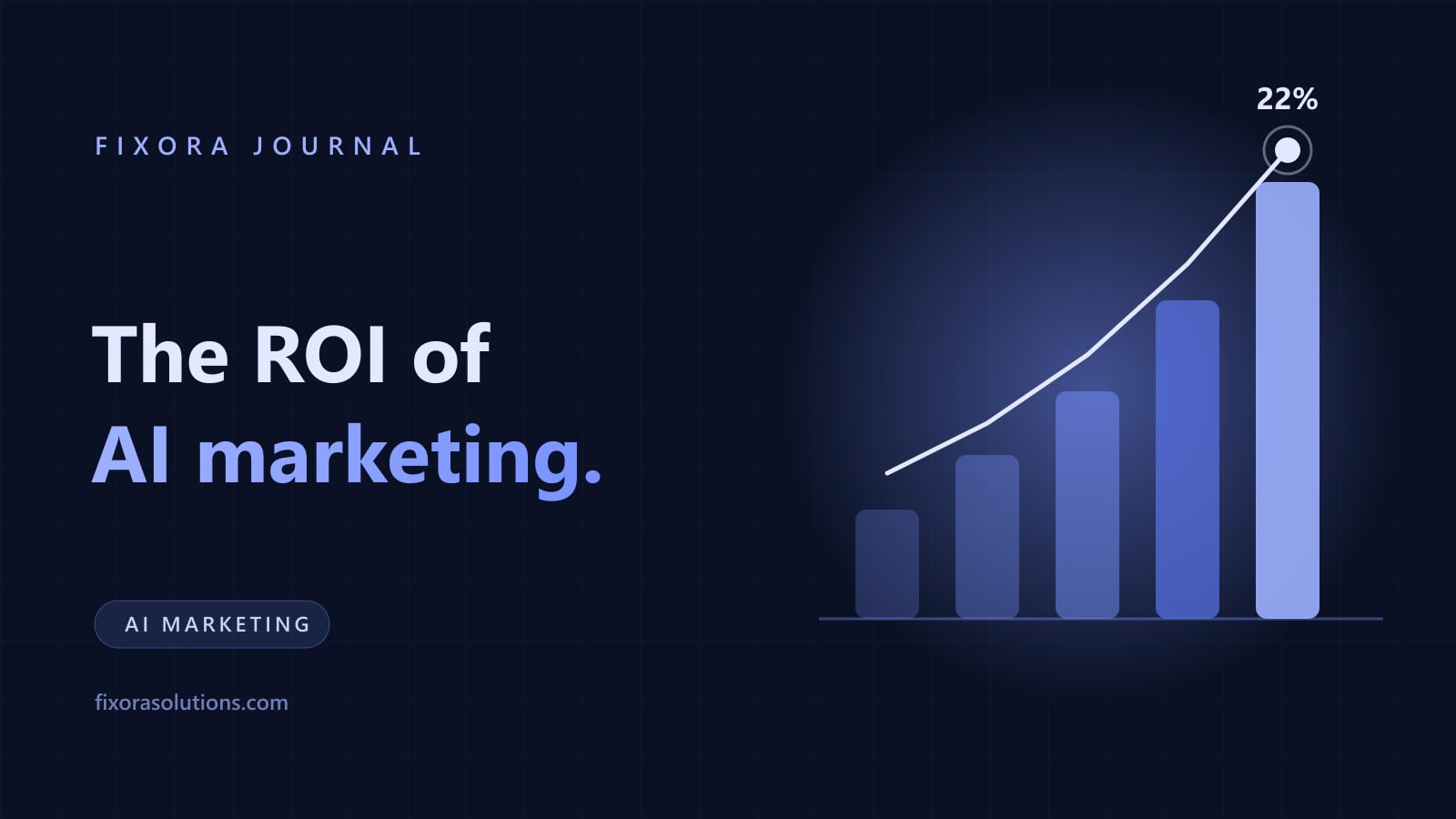
- AI driven campaigns deliver roughly 22% better ROI than traditional campaigns in aggregated 2026 benchmarks.
- Marketers recover an average of 6.1 hours per week using AI, with senior practitioners saving 8 to 10.
That last number is the quiet one that matters most. Six hours a week is 300 hours a year, per marketer. Multiply by loaded salary and the ROI question inverts: the expensive choice is not using AI.
Where AI actually pays back
Adoption data shows small businesses concentrate AI in five places, and the ranking matches what we see in our own client work:
- Email and outbound copy (62% of AI-using small businesses). Personalization at scale is the killer app. Our cold email benchmarks post shows what that looks like against industry reply rates.
- Social media content (58%). Platform native captions from one brief, scheduled across channels. This is exactly what we built Omni Socials to do.
- Blog and website content (49%). Draft speed, not publish speed. The editing bar is where quality lives.
- Chat and lead response (31%). Response time is a conversion variable; AI answers at 2 a.m.
- Ad creative (28%). Variant generation for testing, not final creative.
Where AI quietly wastes money
Honesty section. Three failure modes we consistently see:
- AI content with no editor. Search engines and readers both punish generic text. AI drafts, humans decide. Every post on this blog passes through a human edit, and yours should too.
- Tools without a workflow. A subscription is not a strategy. Teams stack five AI tools, use each at 10%, and call it transformation.
- Automating a broken funnel. If the offer does not convert, AI just delivers the rejection faster. Fix the offer first. Our lead generation teardown covers the usual suspects.
What a realistic AI marketing stack looks like
For a small business in 2026, the working formula is narrow and deep:
- One AI assisted content engine feeding blog and social from a single weekly brief.
- One AI powered outbound or ads channel for predictable pipeline.
- Analytics that a human reads weekly. AI summarizes; a person decides.
That is it. Two channels, one review loop. The 22% ROI advantage comes from consistency and iteration speed, not from tool count.
Frequently asked
Is AI marketing ROI real or hype? The adoption and ROI data above comes from surveys of thousands of businesses. The effect is real, but it concentrates in teams that changed their workflow, not just their software.
How fast should AI marketing show results? Outbound and paid channels: weeks. Content and SEO: months, but compounding. Anyone promising overnight organic results is selling something.
Do I need an agency for this? Not necessarily, but buying a working system beats assembling one alone. We compared the costs honestly in AI agency vs in house.
Want the 22% on your side of the table? Send us your goal and we reply within 24 hours with an honest read on whether AI marketing fits your stage.
Have a project that needs this?
Tell us what you are building. We reply within 24 hours.
The service behind this
AI Marketing Services
A full marketing function without the headcount: strategy, content, campaigns, and outbound, run as one system and reported on the numbers that decide whether it paid.