What Percent of Revenue Should Go to Marketing in 2026?
Benchmark surveys put marketing at roughly 7 to 10% of revenue, with growth stage businesses spending more. How to set your number without guessing or copying.
The benchmark, and why it is only a starting point
Industry surveys have circled the same range for years. Gartner's annual CMO spend research has tracked marketing budgets at roughly 7 to 8% of company revenue in recent cycles, and longstanding guidance for small businesses, including from the US Small Business Administration, sits around 7 to 8% for established companies and above 10% for those pushing growth.
So the honest benchmark: 7 to 10% of revenue, tilting higher when you are new, launching, or in a crowded market, and lower when referrals already fill your pipeline.
But percent of revenue is a sanity check, not a strategy. Two businesses with identical revenue need different budgets depending on one question: what does a customer earn you, and what does acquiring one cost?
The better way: work backwards from a customer
- Lifetime value. Roughly, what a typical customer pays you over the relationship.
- Affordable acquisition cost. A common healthy ratio is a customer worth at least three times what you paid to acquire them.
- The math. If a client is worth 3,000 dollars and a 3 to 1 ratio holds, you can pay up to 1,000 to win one. Ten new clients a quarter justifies a 10,000 dollar quarterly budget, whatever percent of revenue that happens to be.
This reframes marketing from a cost you minimize into a machine you feed while the ratio holds, which is exactly how the ROI data on AI marketing should be read too.
How to split whatever you spend
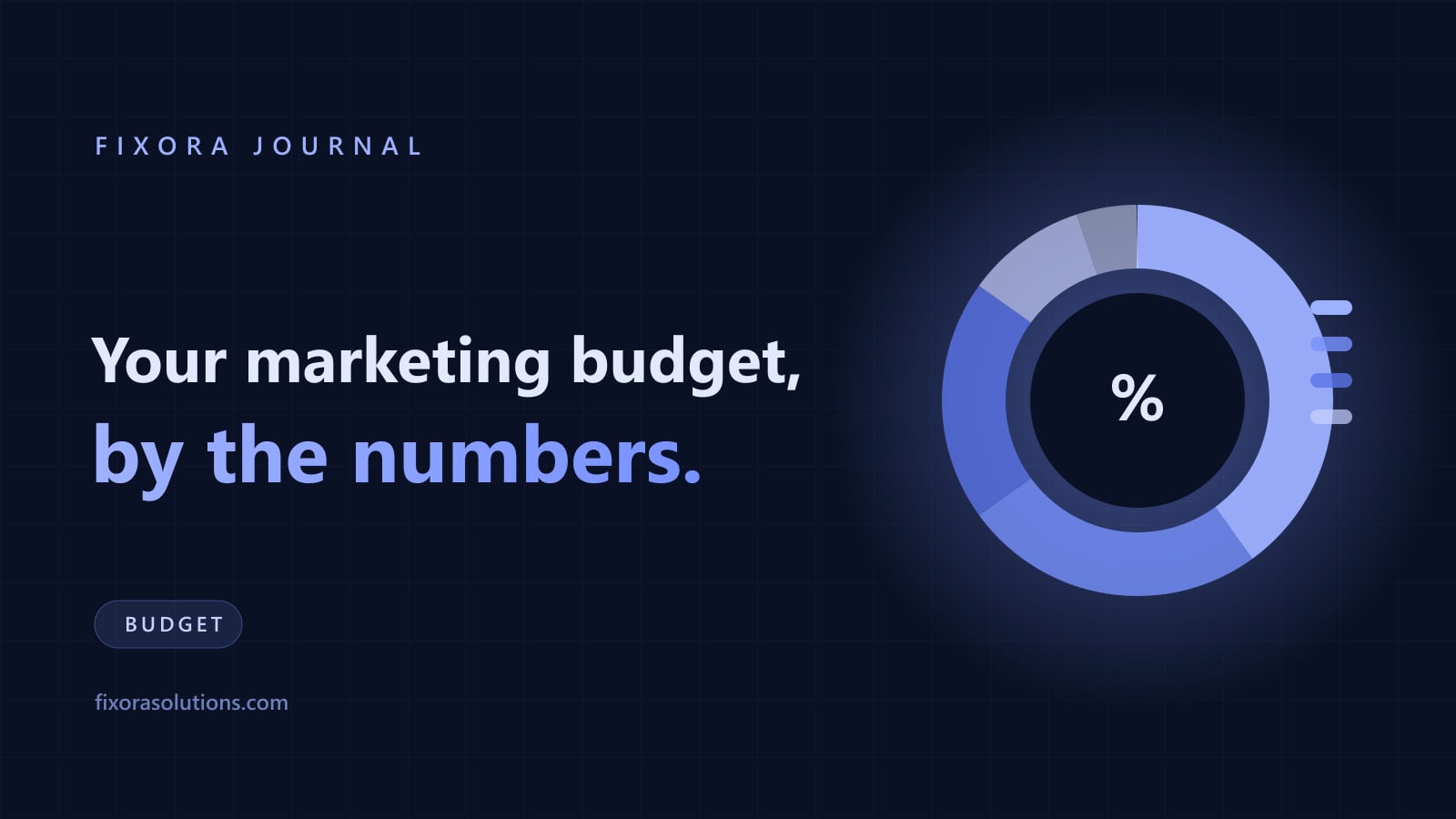
The split we recommend for most small businesses, consistent with our full playbook:
- 40% on one fast channel that produces leads this quarter: paid ads or outbound.
- 25% on production: the video, design, and pages that make every channel convert.
- 20% on compounding assets: SEO and content, email, reviews.
- 10% on experiments, because next year's best channel is this year's test.
- 5% on measurement, the part that makes the other 95% honest.
If your tool subscriptions alone eat a third of the budget, the stack is too heavy for your stage.
When to spend more, and when to stop
Spend above benchmark when: a proven channel is returning above your target ratio (feed it), you are entering a new market, or competitors are buying the attention you need.
Cut or pause when: you cannot state your acquisition cost (fix measurement first), the funnel leaks (fix conversion before buying traffic), or the offer itself is unproven. Marketing multiplies what exists. It cannot invent demand for something nobody wants.
Frequently asked
Does the percent include salaries and tools? Survey definitions vary, which is another reason to prefer the customer math. Decide what you count, then be consistent so trends mean something.
We are pre revenue. What percent applies? None. Spend founder time and small fixed experiments, not percentages of money you do not have yet. The cost guide covers stage appropriate spending.
Can Fixora plan a budget with us? Yes. Every engagement starts by finding your customer math, and we will tell you plainly if the budget you have is better spent differently. Send your numbers and get an honest plan within 48 hours.
Have a project that needs this?
Tell us what you are building. We reply within 24 hours.
The service behind this
AI Marketing Services
A full marketing function without the headcount: strategy, content, campaigns, and outbound, run as one system and reported on the numbers that decide whether it paid.