Working With a Remote Marketing Team Across Time Zones
Time zones are a scheduling problem people mistake for a quality problem. Four hours of overlap and three written habits make a distant team feel closer than the office down the road.
The objection everyone raises first
"They are eight hours ahead, so we lose a day every time we ask a question." That is true if you run a distant team the way you run a colleague at the next desk. It stops being true the moment the work is set up for asynchronous handoff.
There is even an advantage hiding in it. Work briefed at 6pm in London can be finished before the London team logs in. The overnight turnaround is the single most underrated benefit of a distant team, and it only appears when briefs are complete enough to work from without a follow up question.
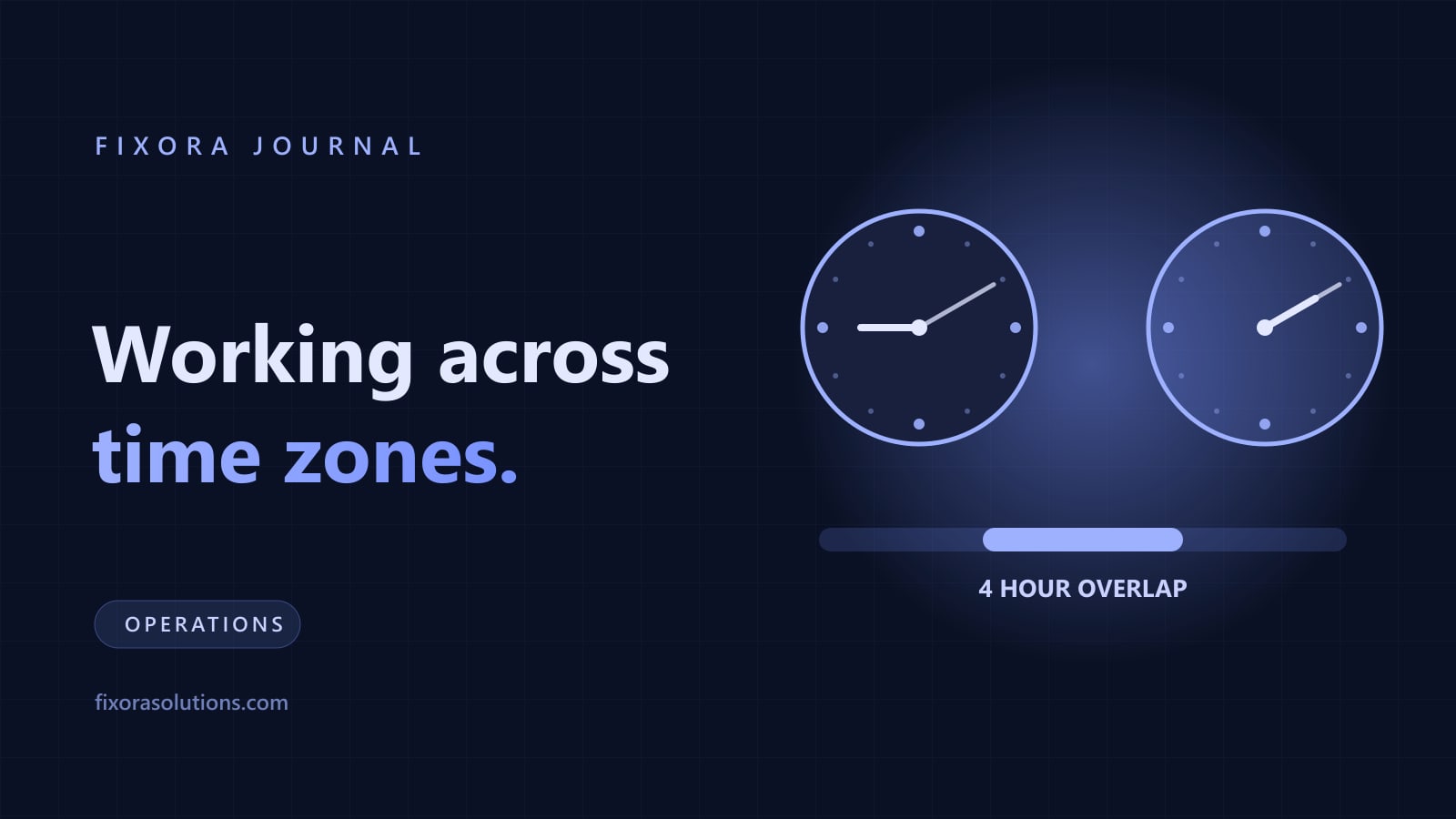
Four hours of overlap is the whole game
You do not need matching working days. You need a reliable window where both sides are awake, and everyone needs to know when it is.
Pakistan sits five hours ahead of London in summer and ten ahead of New York, which puts a natural overlap in the UK morning and the US early morning. For Australian clients the overlap lands in their afternoon. Whatever the pairing, write the window into the contract, put it in both calendars, and treat it as the only time synchronous questions get asked.
Outside that window, everything is written.
The three habits that make it work
1. Briefs that survive without you. A brief that requires a follow up question wastes a full day. Include the objective, the audience, the format and dimensions, the deadline, examples of what good looks like, and what must not happen. This applies double for design work, per the onboarding checklist.
2. End of day handoffs, both directions. A short written note: what moved, what is blocked, what needs a decision before the next session. Five minutes of writing saves a day of waiting.
3. Decisions in writing, in one place. Verbal approval on a call that one side remembers differently is the most common source of rework. If it was not written down, it was not decided.
The meeting rhythm
One thirty minute call a week during the overlap, with an agenda sent beforehand. One monthly review of results against the numbers that matter. Everything else async.
Teams that insist on daily calls with a distant partner are usually compensating for briefs that are too thin. Fix the briefs and the calls become unnecessary.
Tools, kept boring
One place for chat, one for files, one for tasks, one for approvals. Which ones matters far less than everyone using the same four. The failure mode is not a bad tool, it is feedback scattered across email, WhatsApp, and three comment threads, so nobody knows what the current version is.
Version the files. Approve in one thread. Keep the source of truth obvious.
When the distance genuinely hurts
Live event coverage, same day crisis response, and anything needing a physical presence are poor fits for a team on the other side of the world. Say so honestly rather than promising coverage that will not exist at 3am. Everything else in marketing, which is most of it, is asynchronous work that happens to have been done in an office out of habit.
Frequently asked
How much overlap is enough? Four hours reliably. Two can work if briefs are strong and approvals are batched.
Who adjusts, us or them? In practice the partner adjusts, and any good one already does. Ask which hours they cover before you sign, per the offshore hiring guide.
What hours does Fixora cover? We work US, UK, and Australian business hours, with a written overlap window agreed at kickoff. Tell us your time zone and we will show you the schedule.
Have a project that needs this?
Tell us what you are building. We reply within 24 hours.
The service behind this
AI Marketing Services
A full marketing function without the headcount: strategy, content, campaigns, and outbound, run as one system and reported on the numbers that decide whether it paid.