Why a Logo Costs $50 or $50,000 for the Same Number of Pixels
The file is identical in size. What changes across that range is how much thinking is attached to it, how many places it has been tested, and whether you own it.
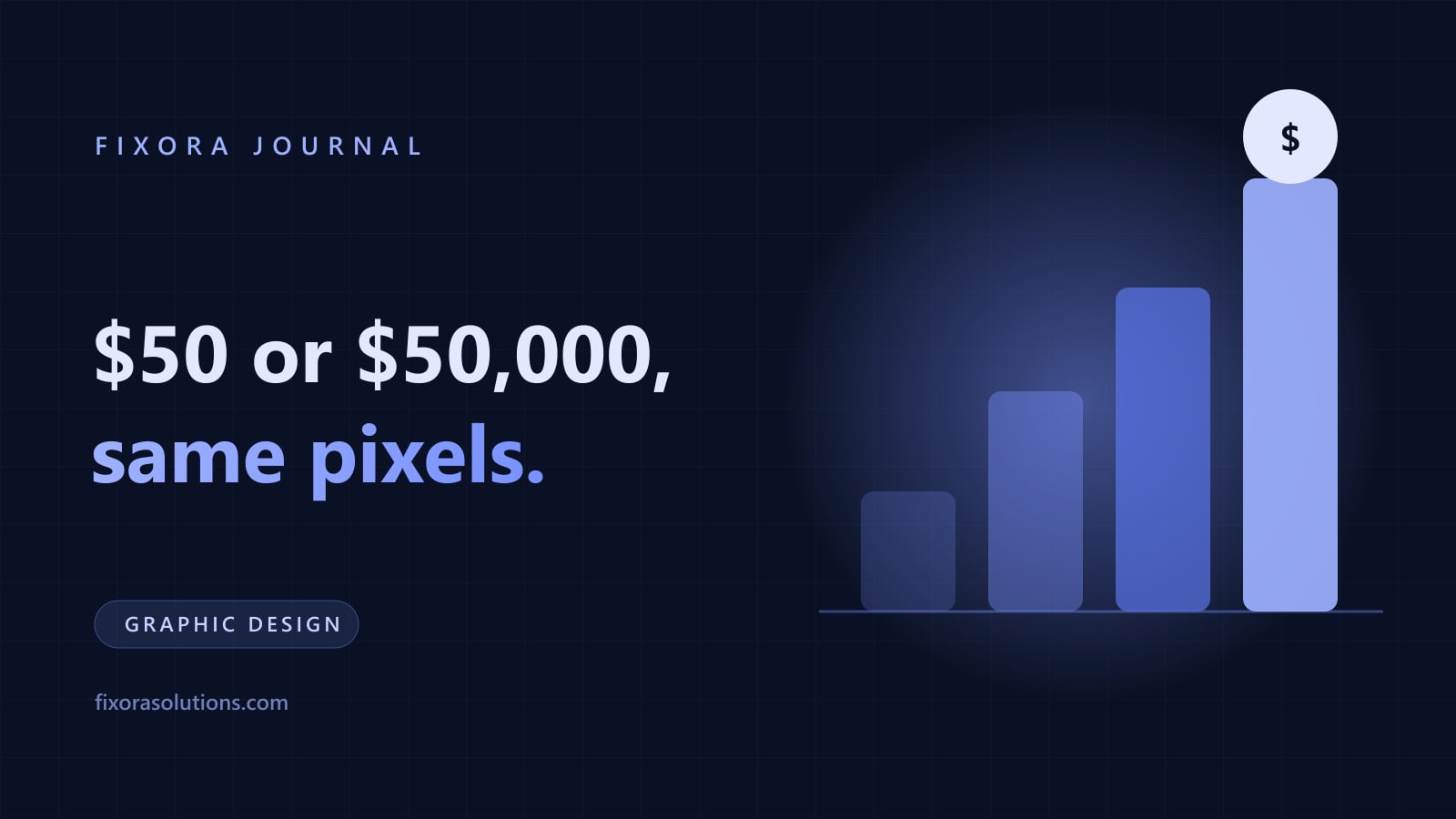
The output looks the same. The asset is not.
Every logo arrives as a handful of files. That is why the price range in this category confuses buyers more than any other: the deliverable looks identical whether you paid fifty or fifty thousand.
What differs is not the drawing. It is the amount of thinking behind the choice, the number of surfaces it has been tested on, and whether it is legally yours.
What each tier buys
Under $100: a generated mark. A logo maker or a marketplace gig. You get a wordmark in a licensed typeface with a stock icon beside it. It is fast and it works if you need something on an invoice this week.
The real risks are not aesthetic. The icon is often non exclusive, meaning another business can buy the same one, and typeface licensing for commercial use is frequently unresolved. Nobody notices until you scale, and then you rebrand.
$300 to $2,000: a designed mark. A competent designer, a few concepts, some revisions. You get an original mark and usually a couple of file formats.
What is normally missing is the system: what happens on a dark background, in one colour, at favicon size, or when someone needs a square avatar. Those gaps get filled by whoever needs the file next, usually badly.
$2,000 to $15,000: an identity system. This is where the price stops being about the logo. You get the mark plus the rules that keep it intact: lockup variants, colour values written down, a typeface with a real weight range, spacing rules, and application to the surfaces you actually use.
The Infix System identity is a fair illustration of what the extra money buys. The wordmark is one deliverable. The connector built into the F, the tested app icon, the palette with hex values recorded, three lockups so nobody improvises a square version, and the proof on cards, apparel, and signage are the rest of it.
$15,000 and up: strategy first. Research, positioning, naming work, competitive audit, and then design. Appropriate when the identity has to carry a market position that does not exist yet, or when the cost of getting it wrong is measured in millions.
The three things that actually justify the jump
Testing at the extremes. A mark that only works at presentation size fails on the favicon, the app icon, and the embroidered polo shirt. Testing at 16 pixels and at signage scale before finalising is a large share of the work in a proper identity, and it is the part cheap logos skip entirely.
Rules written down. A brand without documented colour values and type rules drifts within a year, because every new person who touches it guesses. Documentation is not bureaucracy, it is what makes the asset survive staff turnover.
Ownership. Ask directly: is the copyright assigned to me on payment, are the working files included, and is the typeface licensed for my commercial use? A surprising number of cheap logos fail all three. See scope, IP, and access.
When cheap is the right answer
If you are pre revenue, testing a concept, or genuinely unsure the business will exist in a year, buy the cheap mark and move on. Spending five figures on an identity for a proposition you have not validated is the classic marketing before product market fit mistake.
Rebranding later is annoying but survivable. Running out of money because you designed instead of selling is not.
When it is worth the money
When the brand is the product. Professional services, recruitment, consulting, luxury, and anything where a buyer is assessing your credibility before they can assess your work. In those categories presentation is not decoration, it is most of the available evidence, and the return shows up in whether people take the first meeting. The evidence is in does design quality drive revenue.
Frequently asked
Are logo contests a good idea? You get volume and no thinking, and the ownership position is often unclear. For a mark you intend to keep, no.
Can AI design our logo? It will produce something that looks like a logo. It will not test it at sixteen pixels, resolve the typeface licence, or tell you the mark resembles a competitor's. Those are the parts that matter.
What does Fixora charge? Fixed price per phase, scoped before we start. See how we price and the identity work, then send us your brief for a quote within 48 hours.
Have a project that needs this?
Tell us what you are building. We reply within 24 hours.
The service behind this
Graphic Design
Design that holds up at 16 pixels and across every asset after it. Built as a system your team can actually use without coming back to us for every social post.