You Are Probably Charging Too Little. Here Is How to Find Out
Most owners set prices by looking at costs, guessing a margin, and then flinching. There is a better method, it takes about an hour, and you can run it yourself with fifteen customers and a spreadsheet.
The maths nobody shows you
Start with the reason this matters more than almost anything else you could work on this quarter.
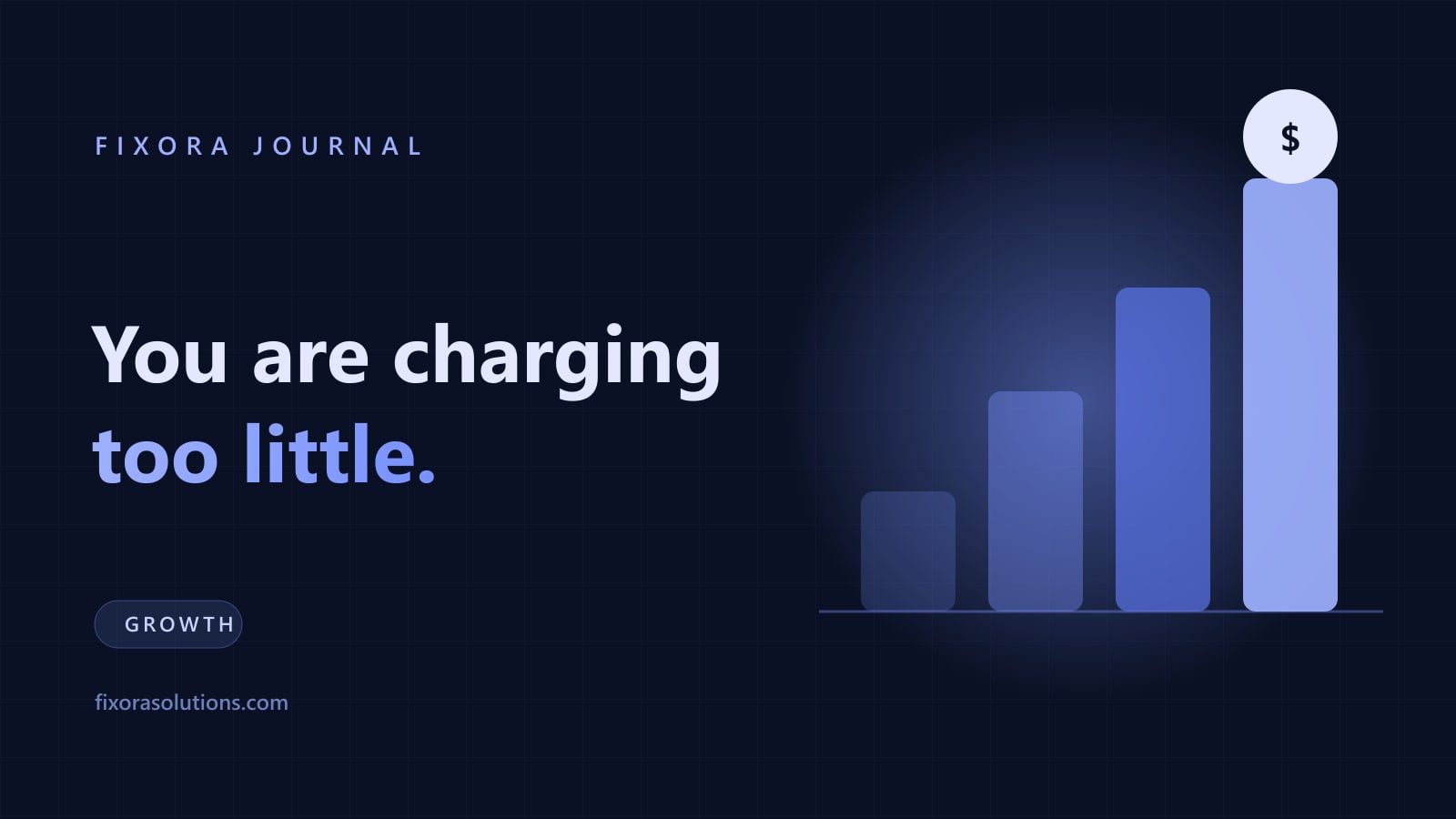
Price falls straight to the bottom line. There is no delivery cost attached to it, no extra hours, no materials. A pound more on the invoice is a pound of profit.
McKinsey's well known work on this, published as The Power of Pricing, put the leverage in stark terms: for the average income statement of an S&P 1500 company, a one percent price rise with volumes held steady produces roughly an eight percent increase in operating profit.
You will see that same finding quoted around the internet as eleven percent, attributed to a McKinsey study of the Global 1200. Both versions circulate. They describe different populations, and the number you meet most often is not the one in McKinsey's own article. I mention it because the exact figure is less important than the shape of it, and because we try not to repeat numbers without checking them.
The shape is what matters. Small price changes move profit far more than equivalent effort spent on volume or cost cutting. Most owners spend their energy on the other two.
Why cost plus quietly caps you
Almost every small firm prices the same way. Work out what it costs to deliver. Add a margin that feels defensible. Round it to something that sounds normal.
The problem is that this method contains no information about the buyer. It tells you what you need. It says nothing about what the work is worth to the person paying, and those two numbers are often nowhere near each other.
I have seen a designer charge four hundred pounds for a logo that let a client raise their own prices for three years. The cost of that afternoon was irrelevant to the outcome. Cost plus pricing had made the afternoon the unit of value, and the afternoon was the least valuable thing in the room.
Cost tells you your floor. It has nothing to do with your ceiling.
The four questions
There is a method for finding the ceiling, and the useful thing is that it is old, simple, and free. It was developed by the Dutch economist Peter van Westendorp in the 1970s and it is still used by pricing researchers today. Sawtooth Software has a clear explainer if you want the full version, and Conjointly has a tool that plots it for you.
You ask four questions about the same offer.
- At what price would this be so cheap that you would question the quality?
- At what price would this be a bargain?
- At what price would this start to feel expensive, but still worth considering?
- At what price would this be so expensive you would not consider it?
That is it. Plot the four curves and the crossing points give you a range where price and perceived value line up.
Two things make this work in practice.
Ask people, not yourself. Fifteen answers from real buyers beats an afternoon of internal debate. Past clients, lost prospects, and people in your market who never bought are all valid, and the third group is the most informative.
Ask about a described offer, not a vague service. Write two sentences describing exactly what they get, then ask the four questions about that. Vague offers produce vague numbers.
How to read it without fooling yourself
Here is the honest caveat, and it is the part most articles on this skip.
The method produces something often called an optimal price point. That name is misleading. What it actually identifies is the price that minimises the share of people who reject you on price. That is not the same as the price that makes you the most money, and it is not a measurement of willingness to pay.
Minimising rejection sounds appealing until you notice what it optimises for. A price that almost nobody objects to is usually a price that is too low, because a healthy price will always lose you some people.
So use the range as a sanity check on your intuition rather than an answer. If your current price sits below the bottom of the acceptable range, you have found something important. If it sits comfortably in the middle, you likely have room above.
Triangulate it with the simplest evidence there is: your win rate. If you win nearly every quote you send, your price is too low. That is not a rule of thumb, it is arithmetic. A price that everyone accepts has left money on every single invoice.
If you have nobody to survey
Not everyone has fifteen buyers to ask. The cheaper version still works.
Raise the price on the next quote only. Not on your existing clients, not on your website. One quote. See what happens. Then the next one. This is the slowest method and the least frightening, and most owners discover the objection they were bracing for does not arrive.
Watch the reaction, not just the outcome. If a prospect accepts without pausing, you are under. If they pause, ask a question, and then agree, you are close to right. If they leave, you have learned where the edge is, and one lost quote is a cheap education.
Count how often you get asked to discount. Rarely means you are cheap.
The awkward part: existing clients
This is where most people stall, so let me be direct about it.
Existing clients are usually the last people you should raise prices on, and the ones owners worry about most. Grandfather them for a defined period. Give proper notice, ideally a full quarter. Tie the increase to something real, whether that is scope, cost, or a change in what you provide.
Some will leave. That is genuinely fine, and the arithmetic usually surprises people. If you raise prices by twenty percent and lose ten percent of clients, you are ahead on revenue and doing less work. The clients you lose in that scenario are almost always the ones who took the most time.
The relevant question is not whether anyone leaves. It is whether the ones who stay are better clients, which they tend to be.
Three things that let you charge more without changing the work
Price is partly a function of perceived risk. Lower the risk and the same work supports a higher number.
Be specific about what happens. A scope with counted deliverables and dates reads as lower risk than a description of effort. This is why proposals that name quantities close better than proposals that describe activity.
Show work that resembles theirs. Not a testimonial saying you were great. A description of a job with the same shape as their job, including what was hard about it.
Say what you will not do. Naming the situations where you are the wrong choice is the single most underrated trust signal in professional services. It reads as confidence, and it costs you only the clients who would have been unhappy anyway.
None of those three require better work. They require clearer description of the work you already do.
If you only do one thing
Take the last ten quotes you sent. Count how many you won.
If it is eight or more, raise your price on the next quote by fifteen percent and send it without commentary. Do not explain, do not apologise, do not add a discount to soften it.
Then watch what happens. In my experience the thing owners fear is not the objection itself. It is finding out the objection never comes, and that the money was there the whole time.
Frequently asked
How often should I revisit pricing? Once a year as a habit, and immediately after any real change in what you deliver.
Should I put prices on my website? Some indication, yes. A range or a starting point disqualifies the wrong enquiries before they cost anyone a meeting. The reasoning is in pricing page psychology.
What if my market is genuinely price sensitive? Some are. Test rather than assume, because "our market is different" is the most common thing owners say shortly before a price rise goes through without complaint.
What if I raise prices and lose work? Then you have found your ceiling, which is information you did not have. Move back down. The experiment costs one quote.
We do not sell pricing consultancy and there is nothing to buy at the end of this one. If you run the exercise and get a result you cannot interpret, send it over and I will tell you what I would do with it.
Have a project that needs this?
Tell us what you are building. We reply within 24 hours.
The service behind this
AI Marketing Services
A full marketing function without the headcount: strategy, content, campaigns, and outbound, run as one system and reported on the numbers that decide whether it paid.